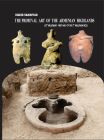
“The Primeval Art of the Armenian Highlands,” presented to the English-speaking reader, is a
revised English version of the monograph published in Armenian by Hakob Yervand Simonyan
in 2023, which encompasses the ancient art of the Armenian Highlands from the Mesolithic
through the Early Bronze Age inclusive. The monograph incorporates all artistic domains of the
highlands that have reached us: cave painting, rock art, works of applied art, architecture,
stone and terracotta sculpture, ceramic ornamentation, jewelry art, and more. As a guide, each
chapter begins with a historical-cultural overview of the epoch, which makes the artistic
domains of the given period and their perception more comprehensible.
It is certain that the region representing a single historical-cultural entity is partially called
Eastern Anatolia by most contemporary researchers, and partially South Caucasus. In both
cases, political circumstances underlie these designations, since in antiquity this region was not
called Eastern Anatolia or South Caucasus. Taking as a foundation the definition of German
scholar Hermann Abich, who, proceeding from physico-geographical and climatic conditions,
named this region the Armenian Highlands, we have applied the designation he proposed.
Underlying this approach is the circumstance that a series of ancient cultures, such as cave
painting, rock art, and various artistic domains of the Pre-Pottery Neolithic, Neolithic,
Chalcolithic, and Early Bronze Age, are common to both the so-called Eastern Anatolia and the
South Caucasus. Meanwhile, the western regions of Georgia—Colchis, which is included in
the South Caucasus—constitute an entirely different cultural area, where civilizations distinct
from the cultures of the Armenian Highlands have existed since ancient times. Consequently, it
is logical to call the art of our study area the culture of the Armenian Highlands, whose
northern boundary is the Kura River and southern boundary is the Armenian Taurus mountain range.
Synthesizing more than ten thousand years of cultures in this region into a single unified book
was a challenging yet important mission. Currently, Armenians, Georgians, Azerbaijanis,
Turks, Persians, Kurds, and other peoples live in this physico-geographical environment, each
of whom considers the ancient culture and art of the Armenian Highlands to be the heritage of
their ancestors. Therefore, this monograph should have a wide readership interested in
studying and preserving the ancient art of the Armenian Highlands, which has its unique and
important role in world heritage.